Dental Bridges in Edinburgh
A dental bridge fills a gap left by one or more missing teeth without the need for surgery. Fixed, stable, and natural-looking.
OVERVIEW
Citrus Dental Care provides dental bridges at 1 Meadow Place, Edinburgh EH9 1JZ, near The Meadows. A dental bridge is a fixed restoration used to replace one or more missing teeth by anchoring a false tooth to the natural teeth or implants on either side of the gap. Bridges start from £570 per unit. Dental bridges are available as both NHS and private treatment where clinically necessary. Finance is available through Tabeo, subject to status for private bridge treatment.
What Is a Dental Bridge and How Does It Work?
You’ve been managing the gap since the tooth came out. You’ve learned which side to chew on. You’ve got used to avoiding certain foods. You don’t let yourself think about it too much when you’re out for a walk across The Meadows, catching your reflection in a window. But a gap in your teeth does more than affect how you look. The teeth on either side begin to drift towards the space over time. The tooth above or below the gap starts to over-erupt. Chewing becomes increasingly uneven. The longer a missing tooth is left unreplaced, the more complicated restoring it eventually becomes.
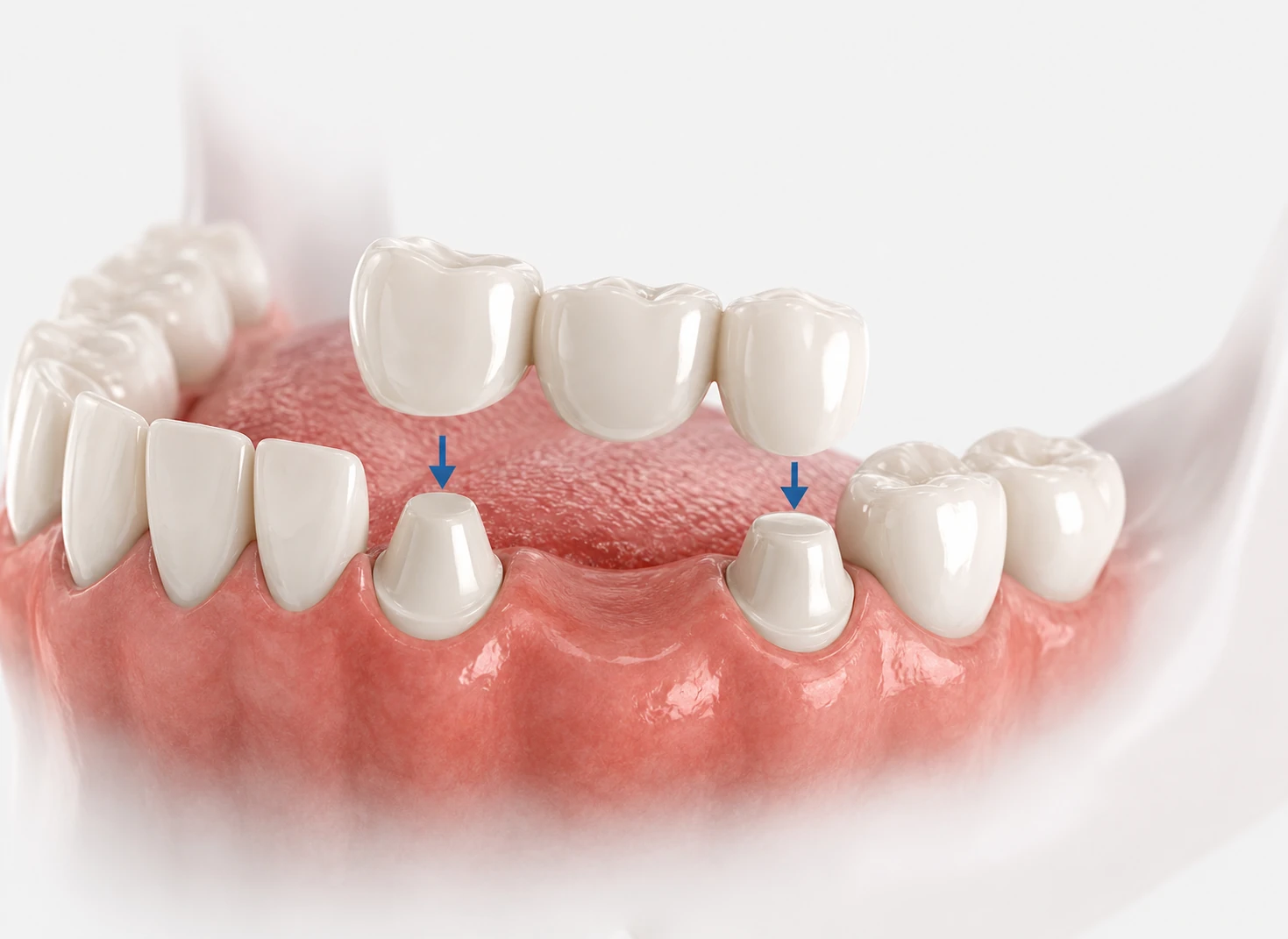
A dental bridge is a fixed restoration that closes the gap by anchoring a false tooth, called a pontic, to the natural teeth on either side of the space. Those anchor teeth, called abutment teeth, are prepared and fitted with crowns that hold the bridge firmly in position. The result is a stable, natural-looking replacement that you treat exactly like your own teeth, brush normally, eat normally, and don’t remove at night. A bridge can also be supported by dental implants rather than natural teeth, which is often the preferred solution when multiple adjacent teeth are missing.
Is a Dental Bridge Right for Me?
A dental bridge is well suited to patients who are missing one or two adjacent teeth and have healthy, stable teeth on either side of the gap suitable to support the bridge. It provides a fixed, non-removable solution that doesn’t involve surgery, making it a good option for patients who want to avoid or aren’t suitable for implants.
The key consideration is the abutment teeth. Bridge preparation involves shaping the supporting teeth to receive crowns, which is a permanent alteration. If those teeth are otherwise healthy, a bridge commits them to being crowned for life. For this reason, implant-supported replacement is often worth considering as an alternative if the supporting teeth are sound, since an implant doesn’t require any alteration to neighbouring teeth.
Your dentist will discuss both options honestly at the appointment and help you decide which approach makes the most sense for your specific situation.
What Does the Process Look Like?
Your Dental Bridge at Citrus covers more ground than you might expect.
-
1Examination and assessmentYour dentist examines the gap, the supporting teeth, and takes X-rays to confirm the health of the abutment teeth and surrounding bone before planning treatment.
-
2Tooth preparationThe abutment teeth on either side of the gap are carefully shaped to receive the crowns that will hold the bridge in position. Local anaesthetic is used throughout.
-
3ImpressionsDetailed impressions or digital scans of the prepared teeth and the gap are taken and sent to a dental laboratory where your bridge is custom-made.
-
4Temporary bridgeA temporary bridge is placed while your permanent restoration is being made, usually one to two weeks, to protect the prepared teeth and maintain your appearance.
-
5Bridge fittingYour permanent bridge arrives from the laboratory. Your dentist checks the fit, bite, and appearance carefully before cementing it permanently in place.
-
6Aftercare adviceYou'll receive guidance on how to clean underneath the bridge using interdental brushes or floss threaders, which is essential for keeping the supporting teeth and gum healthy long-term.
How Much Does a Dental Bridge Cost in Edinburgh?
Dental bridges at Citrus start from £570 per unit. A three-unit bridge replacing one missing tooth, which consists of two crowns on the abutment teeth and one false tooth between them, starts from £1,710 in total.
The final cost depends on the number of units in the bridge, the materials used, and the complexity of the case. Your dentist will provide a clear written quote after the assessment appointment before any treatment is agreed.
NHS patients are eligible for bridges where clinically necessary under the standard NHS band charge and the £384 per course maximum.
We See Patients From Across Edinburgh and Beyond
We see bridge patients from across Edinburgh’s Southside including Newington, Bruntsfield, Tollcross, Marchmont, Morningside, and Leith, as well as patients from across the wider Edinburgh and Lothians area. If you’ve been living with a gap and you’re ready to sort it properly, come and see us on Meadow Place.
Not sure where to begin? Just give us a ring.
Make an Enquiry
Spread the Cost of Your Bridge With Finance
For patients having a private bridge, Tabeo finance lets you spread the cost into fixed monthly payments with no interest and no early repayment penalty. We’ll confirm your total cost at the assessment appointment and walk you through the finance options before anything is agreed.
REGISTRATION
Register With Citrus Dental Care
New to the area, returning after a while away, or just finally getting round to that appointment you’ve been putting off. You’re welcome here and registering is straightforward.
Here’s what you get when you join us:
- Free NHS check-ups for all registered patients
- Same-day emergency appointments when you need them
- A friendly, consistent team who gets to know you
- Membership plans from £22.50 a month
- Spread the cost of private treatment with Tabeo
- Gentle, unhurried care at whatever pace suits you
NHS patients are very welcome. We’re currently accepting new NHS registrations alongside private patients, which we know isn’t something every Edinburgh practice can say right now.
FAQs
Frequently Asked Questions About Dental Bridge
A well-made and well-maintained dental bridge typically lasts ten to fifteen years, sometimes considerably longer. Longevity depends on the quality of the original work, how well the bridge and supporting teeth are cleaned, and the health of the gums and bone over time. Regular check-ups and hygiene appointments are essential for monitoring the bridge and the teeth supporting it.
A bridge is fixed in place, so floss can't pass through the contact points the way it does with natural teeth. Cleaning underneath the bridge, in the space between the false tooth and the gum, requires either floss threaders, interdental brushes of the correct size, or a water flosser. Diana, our hygienist, will show you the right technique and tools at your hygiene appointment.
A bridge is fixed to the natural teeth on either side of the gap and involves permanently altering those teeth to receive crowns. An implant stands independently in the jaw without affecting neighbouring teeth and prevents bone loss beneath the gap. Bridges are generally faster and less expensive to place. Implants last longer, preserve the jaw bone, and don't involve altering healthy adjacent teeth. Your dentist will discuss both honestly and help you decide which is more appropriate.
Yes. An implant-supported bridge is often the preferred solution when multiple adjacent teeth are missing, since it avoids the need to involve and permanently alter the natural teeth on either side of the gap. Dr Bousis will advise on whether an implant-supported bridge is an option for your specific case.
Yes, where clinically necessary. NHS bridge treatment is subject to the standard Scottish band charge and the £384 per course maximum. Speak to our team when you call and we'll confirm whether your situation qualifies for NHS treatment.